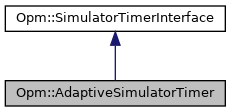
Simulation timer for adaptive time stepping. More...
#include <AdaptiveSimulatorTimer.hpp>
Public Member Functions | |
| AdaptiveSimulatorTimer (const boost::posix_time::ptime simulation_start_time, const double step_length, const double elapsed_time, const double last_step_taken, const int report_step, const double max_time_step=std::numeric_limits< double >::max()) | |
| constructor taking a simulator timer to determine start and end time More... | |
| AdaptiveSimulatorTimer & | operator++ () |
| advance time by currentStepLength More... | |
| void | advance () override |
| advance time by currentStepLength More... | |
| void | provideTimeStepEstimate (const double dt_estimate) |
| provide and estimate for new time step size More... | |
| bool | initialStep () const override |
| Whether this is the first step. More... | |
| int | currentStepNum () const override |
| int | reportStepNum () const override |
| return current report step More... | |
| double | currentStepLength () const override |
| void | setCurrentStepLength (double dt) |
| double | totalTime () const |
| double | simulationTimeElapsed () const override |
| bool | done () const override |
| double | averageStepLength () const |
| return average step length used so far More... | |
| double | maxStepLength () const |
| return max step length used so far More... | |
| double | minStepLength () const |
| return min step length used so far More... | |
| double | stepLengthTaken () const override |
| Previous step length. This is the length of the step that was taken to arrive at this time. More... | |
| void | report (std::ostream &os) const |
| report start and end time as well as used steps so far More... | |
| boost::posix_time::ptime | startDateTime () const override |
| start date time of simulation More... | |
| bool | lastStepFailed () const override |
| Return true if last time step failed. More... | |
| void | setLastStepFailed (bool last_step_failed) |
| tell the timestepper whether timestep failed or not More... | |
| double | reportStepStartTime () const |
Reservoir coupling constructs a fresh timer per sync chunk, so start_time_, total_time_, and current_step_ describe the chunk rather than the enclosing report step. The accessors below return a "report step view" that the rescoup outer loop populates (via the setters) so that log lines can show the report-step start and end and a substep counter that increments across chunks. When the view is not set, they fall through to the per-timer fields, so the non-rescoup path's behavior and output are unchanged. More... | |
| double | reportStepTotalTime () const |
| int | reportStepSubstepNum () const |
| void | setReportStepStartTime (double t) |
| void | setReportStepTotalTime (double t) |
| void | setReportStepSubstepOffset (int n) |
| int | reportStepSubstepOffset () const |
| std::unique_ptr< SimulatorTimerInterface > | clone () const override |
| return copy of object More... | |
| virtual boost::posix_time::ptime | currentDateTime () const |
| Return the current time as a posix time object. More... | |
| virtual time_t | currentPosixTime () const |
| virtual double | reportStepLengthTaken () const |
Protected Attributes | |
| std::shared_ptr< boost::posix_time::ptime > | start_date_time_ |
| const double | start_time_ |
| const double | total_time_ |
| const int | report_step_ |
| const double | max_time_step_ |
| double | current_time_ |
| double | dt_ |
| int | current_step_ |
| std::vector< double > | steps_ |
| bool | last_step_failed_ |
| std::optional< double > | report_step_start_time_ |
| Optional report-step start time for the "report step view" accessors. Set by the rescoup outer loop on each per-sync-chunk timer; unset on a non-rescoup timer. More... | |
| std::optional< double > | report_step_total_time_ |
Optional report-step end time for the "report step view" accessors. Same population pattern as report_step_start_time_. More... | |
| int | report_step_substep_offset_ = 0 |
Number of substeps already taken in this report step before this timer was constructed (i.e. in earlier sync chunks). Added to current_step_ by reportStepSubstepNum() to give a counter that increments across sync chunks. Zero on a non-rescoup timer. More... | |
Detailed Description
Simulation timer for adaptive time stepping.
Constructor & Destructor Documentation
◆ AdaptiveSimulatorTimer()
| Opm::AdaptiveSimulatorTimer::AdaptiveSimulatorTimer | ( | const boost::posix_time::ptime | simulation_start_time, |
| const double | step_length, | ||
| const double | elapsed_time, | ||
| const double | last_step_taken, | ||
| const int | report_step, | ||
| const double | max_time_step = std::numeric_limits< double >::max() |
||
| ) |
constructor taking a simulator timer to determine start and end time
- Parameters
-
simulation_start_time Start time for simulation step_length Time step length elapsed_time Current elapsed time last_step_taken Last suggested time step report_step Current report step index max_time_step maximum time step allowed
Member Function Documentation
◆ advance()
|
inlineoverridevirtual |
◆ averageStepLength()
| double Opm::AdaptiveSimulatorTimer::averageStepLength | ( | ) | const |
return average step length used so far
◆ clone()
|
overridevirtual |
return copy of object
Implements Opm::SimulatorTimerInterface.
◆ currentDateTime()
|
virtualinherited |
Return the current time as a posix time object.
Reimplemented in Opm::SimulatorTimer.
◆ currentPosixTime()
|
virtualinherited |
Time elapsed since the start of the POSIX epoch (Jan 1st, 1970) until the current time step begins [s].
Reimplemented in Opm::SimulatorTimer.
◆ currentStepLength()
|
overridevirtual |
Implements Opm::SimulatorTimerInterface.
◆ currentStepNum()
|
overridevirtual |
Implements Opm::SimulatorTimerInterface.
◆ done()
|
overridevirtual |
Implements Opm::SimulatorTimerInterface.
◆ initialStep()
|
overridevirtual |
Whether this is the first step.
Implements Opm::SimulatorTimerInterface.
◆ lastStepFailed()
|
inlineoverridevirtual |
Return true if last time step failed.
Implements Opm::SimulatorTimerInterface.
References last_step_failed_.
◆ maxStepLength()
| double Opm::AdaptiveSimulatorTimer::maxStepLength | ( | ) | const |
return max step length used so far
◆ minStepLength()
| double Opm::AdaptiveSimulatorTimer::minStepLength | ( | ) | const |
return min step length used so far
◆ operator++()
| AdaptiveSimulatorTimer & Opm::AdaptiveSimulatorTimer::operator++ | ( | ) |
advance time by currentStepLength
Referenced by advance().
◆ provideTimeStepEstimate()
| void Opm::AdaptiveSimulatorTimer::provideTimeStepEstimate | ( | const double | dt_estimate | ) |
provide and estimate for new time step size
◆ report()
| void Opm::AdaptiveSimulatorTimer::report | ( | std::ostream & | os | ) | const |
report start and end time as well as used steps so far
◆ reportStepLengthTaken()
|
inlinevirtualinherited |
Previous report step length. This is the length of the step that was taken to arrive at this report step time.
- Note
- if no increments have been done (i.e. the timer is still in its constructed state and reportStepNum() == 0), it is an error to call stepLengthTaken().
References Opm::SimulatorTimerInterface::stepLengthTaken().
◆ reportStepNum()
|
overridevirtual |
return current report step
Reimplemented from Opm::SimulatorTimerInterface.
◆ reportStepStartTime()
| double Opm::AdaptiveSimulatorTimer::reportStepStartTime | ( | ) | const |
Reservoir coupling constructs a fresh timer per sync chunk, so start_time_, total_time_, and current_step_ describe the chunk rather than the enclosing report step. The accessors below return a "report step view" that the rescoup outer loop populates (via the setters) so that log lines can show the report-step start and end and a substep counter that increments across chunks. When the view is not set, they fall through to the per-timer fields, so the non-rescoup path's behavior and output are unchanged.
◆ reportStepSubstepNum()
| int Opm::AdaptiveSimulatorTimer::reportStepSubstepNum | ( | ) | const |
◆ reportStepSubstepOffset()
|
inline |
References report_step_substep_offset_.
◆ reportStepTotalTime()
| double Opm::AdaptiveSimulatorTimer::reportStepTotalTime | ( | ) | const |
◆ setCurrentStepLength()
| void Opm::AdaptiveSimulatorTimer::setCurrentStepLength | ( | double | dt | ) |
◆ setLastStepFailed()
|
inline |
tell the timestepper whether timestep failed or not
References last_step_failed_.
◆ setReportStepStartTime()
|
inline |
References report_step_start_time_.
◆ setReportStepSubstepOffset()
|
inline |
References report_step_substep_offset_.
◆ setReportStepTotalTime()
|
inline |
References report_step_total_time_.
◆ simulationTimeElapsed()
|
overridevirtual |
Implements Opm::SimulatorTimerInterface.
◆ startDateTime()
|
overridevirtual |
start date time of simulation
Implements Opm::SimulatorTimerInterface.
◆ stepLengthTaken()
|
overridevirtual |
Previous step length. This is the length of the step that was taken to arrive at this time.
Implements Opm::SimulatorTimerInterface.
◆ totalTime()
| double Opm::AdaptiveSimulatorTimer::totalTime | ( | ) | const |
Member Data Documentation
◆ current_step_
|
protected |
◆ current_time_
|
protected |
◆ dt_
|
protected |
◆ last_step_failed_
|
protected |
Referenced by lastStepFailed(), and setLastStepFailed().
◆ max_time_step_
|
protected |
◆ report_step_
|
protected |
◆ report_step_start_time_
|
protected |
Optional report-step start time for the "report step view" accessors. Set by the rescoup outer loop on each per-sync-chunk timer; unset on a non-rescoup timer.
Referenced by setReportStepStartTime().
◆ report_step_substep_offset_
|
protected |
Number of substeps already taken in this report step before this timer was constructed (i.e. in earlier sync chunks). Added to current_step_ by reportStepSubstepNum() to give a counter that increments across sync chunks. Zero on a non-rescoup timer.
Referenced by reportStepSubstepOffset(), and setReportStepSubstepOffset().
◆ report_step_total_time_
|
protected |
Optional report-step end time for the "report step view" accessors. Same population pattern as report_step_start_time_.
Referenced by setReportStepTotalTime().
◆ start_date_time_
|
protected |
◆ start_time_
|
protected |
◆ steps_
|
protected |
◆ total_time_
|
protected |
The documentation for this class was generated from the following file: